
1 First Reading Excerpts of Digital Garden Websites
This notebook is regularly updated.
This research started in September 2024 with an investigation of the main conceptual ideas of Digital Gardening described by the cultural anthropologist and lead design engineer at Normally Maggie Appleton. Appleton (2020) defines “digital gardening” as an individual practice for idea generation and collection, personal note-taking and knowledge management that is not following the conventions of the otherwise known techniques of personal blogging. Usually, small collections of personal knowledge are created on the web:
“Rather than presenting a set of polished articles, displayed in reverse chronological order, these sites act more like free form, work-in-progress wikis” (Appleton, 2020).
In other words, a garden is a flexible collection of evolving ideas connected through contextual associations rather than organised by publication date. These notes are usually incomplete, exploratory thoughts that develop and become rigid over time, but they are less polished compared to traditional personal websites.
This more or less lengthy video presentation in Figure 1 describes this concept:
2 What Technology do I use?
After browsing the web on my phone, I was wondering how I could clip all the links, documents, quotes etc. Instead of sending everything to a bookmark clipper or other software, I discover the open-source and multi-format academic manuscript writing tool called Quarto. This is a publishing system that allows users to create and publish a wide variety of documents, including reports, websites, blogs, presentations, and more. All text and code is written with in the Markdown format. For this, RStudio is currently a suitable editor.
Besides that, I use Tana (previously Roam Research) on a regularly basis as a go-to tool to store all the links and quotes for personal knowledge management.
3 Discovery of the Digital Gardens
This is what I found: There are a number of educators and people from the creative industry that are interested in digital gardening. Most pages, blogs, websites work with analogies and metaphors.
Tim Rodenböcker describes in his blogpost “How I built myself a Digital Garden” (Rodenbröker, 2023) how he uses ‘clouds-drops-plants’ as artefacts of his thinking, ideation and content creation process. He refers to some of the ideas used in the ‘second brain’ concept by Tiago Fortes (see Figure 2):
“Clouds are notes and excerpts from concrete sources. These can be books, podcast episodes, or press articles. Each cloud is a separate text file in Markdown format. I have now created such a file for all the books I have had in my hands in the last few years. I write a note there when I find a thought interesting while reading or listening to it. Drops are fragments that are too small to represent an independent text. They are tiny stores of information, paragraphs, but also lists and loose notes. Sometimes it’s just a headline. Plants are text projects. I learned the idea from Tiago Forte: he advises to organize one’s knowledge in idea management tools basically in text projects” (Rodenbröker, 2023).
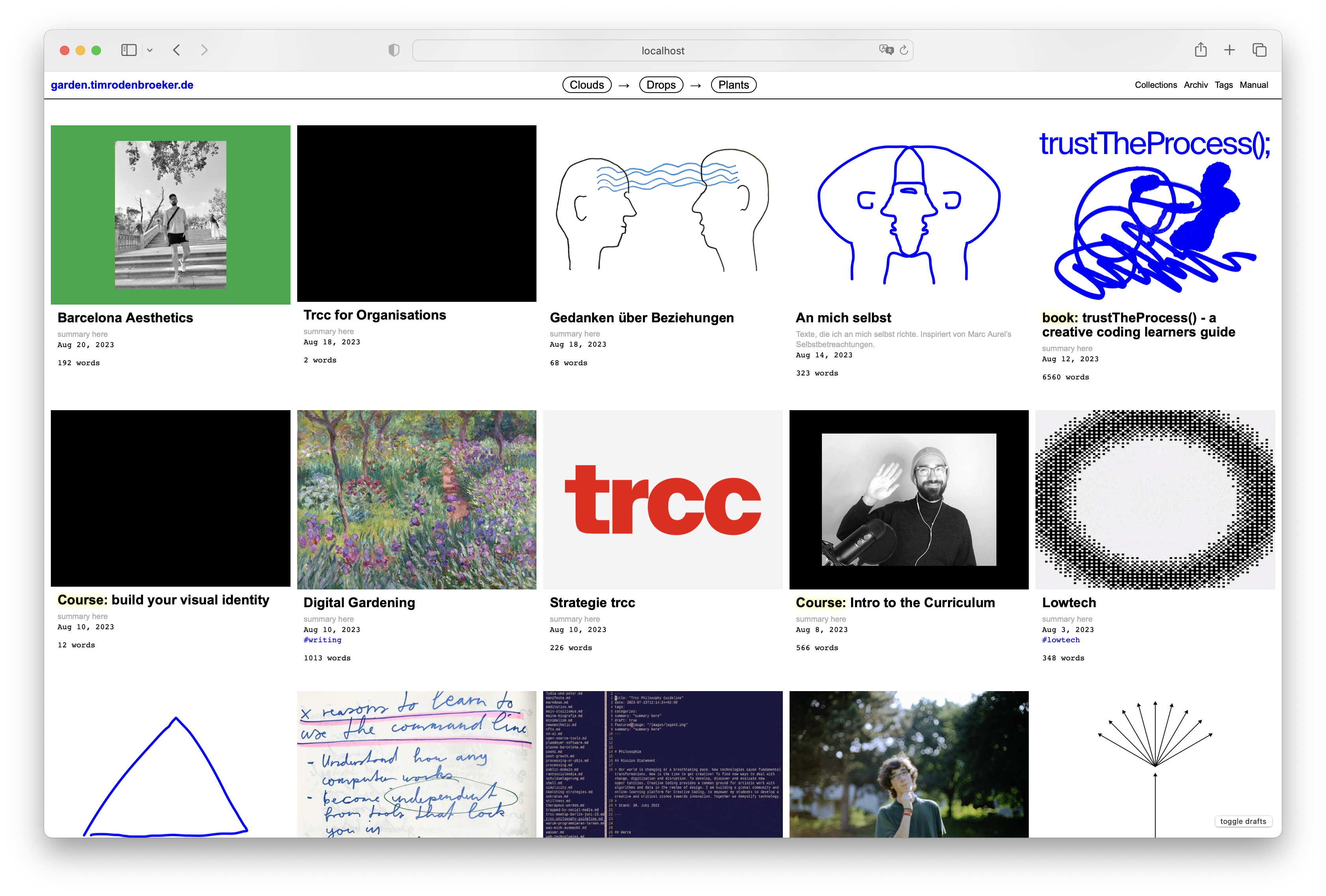

“I have now created such a file for all the books I have had in my hands in the last few years. I write a note there when I find a thought interesting while reading or listening to it. Drops are fragments that are too small to represent an independent text. They are tiny stores of information, paragraphs, but also lists and loose notes. Sometimes it’s just a headline” (Rodenbröker, 2023).
4 Conclusion
To conlude for today, digital gardens provide a dynamic and creative framework for personal knowledge management, seamlessly blending flexible idea cultivation with modern digital tools to enhance individual learning and creativity.
References
Citation
@online{arnold2024,
  author = {Arnold, Maik},
  title = {Digital {Garden} {Notebook}},
  date = {2024-09-15},
  langid = {en},
  abstract = {In September 2024, I started my Master’s thesis at Hamburg
    University that deals with the use of digital gardening as a
    pedagogical practice for university teachers. This notebook contain
    all contents of my field research in order to identify such
    practices.}
}