PKM
Today I presented a paper at the ICEDU 2026 conference in Bali, Indonesia virtually — and the feedback was genuinely encouraging. My paper discussed “Knowledge Governance in the Age of GenAI: How Digital Gardening Transforms University Teachers’ Academic Development” and draws on my master’s thesis completed at University of Hamburg last year (Arnold, 2025). This links to my research in the field Personal Knowledge Management (PKM).
The core question I was trying to answer: how do university educators actually experience digital gardening — not as an abstract concept, but as a lived practice for professional development? And what does that mean for their capacity to govern their own knowledge in an era of generative AI?
I adopted a phenomenographic approach (Marton, 1981), which is well suited to mapping the qualitatively different ways people experience a phenomenon. The sample was small but purposeful and provided some variation: six expert interviews with educators from Germany, the Netherlands, Finland, and Italy, across three disciplines, e.g. teacher education, design studies, and computer sciences.
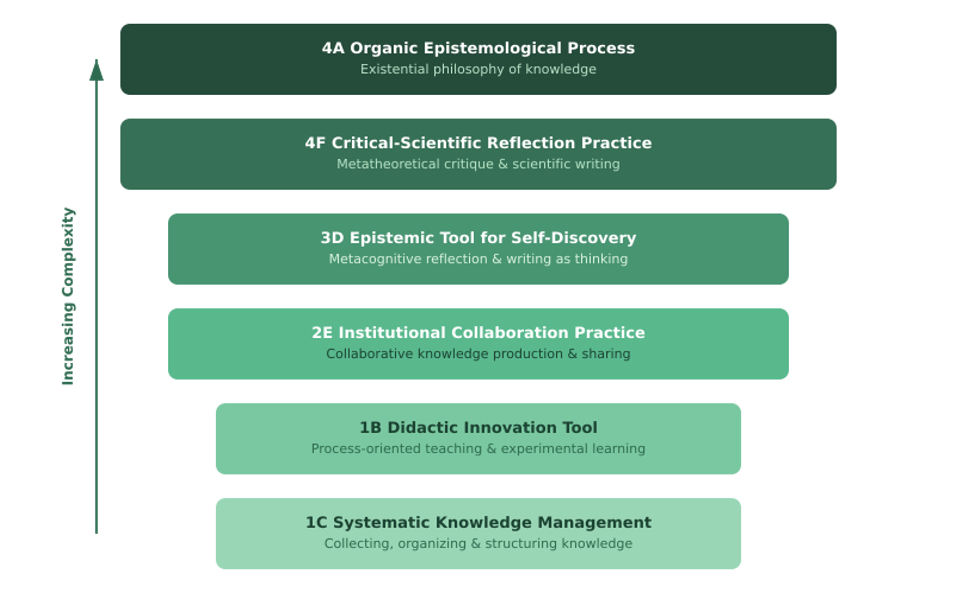
The analysis produced an outcome space of six categories of description — a developmental spectrum from instrumental use to existential philosophy:
Figure 1. Six Categories of Description (author’s own illustration)
Table 1. Brief Summary of the Development Stages (author’s own research)
| Category | Level | Description |
|---|---|---|
| 1C | Lower | Systematic knowledge management — DG as a method for organising and linking scientific work |
| 1B | Lower | Didactic innovation — DG as a pedagogical tool, normalising imperfection and process |
| 2E | Middle | Institutional collaboration — DG as infrastructure for collective knowledge production |
| 3D | Middle | Epistemic self-discovery — writing as thinking, a “litmus test” for understanding |
| 4F | Higher | Critical-scientific reflection — deconstructing PKM myths, countering digital fragmentation |
| 4A | Higher | Organic epistemological process — DG as an existential philosophy, a “life model” |
The key insight is a trajectory: from instrument to organize knowledge to an philosophical approach. At the lower end, educators use digital gardens to organise and teach. At the higher end, the garden becomes a way of being with knowledge — rhizomatic, non-linear, and critically engaged with the technologies that mediate it.
The framework concept in the paper is knowledge governance competence: This points to the capacity to take responsible ownership over one’s knowledge practices in AI-mediated academic environments. This involves more than digital literacy. It means critically evaluating GenAI outputs, making transparent decisions about when and how to delegate cognitive tasks to AI, and developing a reflexive relationship with the tools you use.
Digital gardening, I argued, is one of the few PKM practices that naturally cultivates this sort of competence. It slows you down. It makes your thinking visible. It forces you to take accountability of your ideas formation process rather than outsourcing them.
The discussion after the presentation was inspiring and surfaced some genuinely rich examples from participants’ own practice.
One participant shared that they had used AI to find literary sources for a book they co-authored — a concrete instance of teacher agency in action. That example clicked well with the digital gardening argument: finding resources and collecting them in one place is at the heart of the practice. Done consistently, on a daily basis, it creates the conditions for new book ideas to emerge organically. It is not just generative accumulation — it is curation.
There were also sharp questions about entry barriers and required competences. One participant asked what key competences are needed to participate in digital gardening, and what barriers participants in DG had encountered. The most practical answer from the floor: the first step is finding a tool for thought you can commit to — Obsidian, Tana, Logseq, Roam Research — and becoming genuinely familiar with it. After that, the harder work is developing a personal strategy and structure. The tool is the easy part.
Another participant shared that they use AI to build learning websites for their students — vibe coding, essentially — without being a developer or IT specialist. That sparked a small side-thread about what is now possible for educators who previously had no access to those skills. It maps neatly onto the lower-order categories in the outcome space: AI as an instrument that extends what you can organise and share.
A more theoretically pointed question came from the floor: how does digital gardening specifically enhance knowledge governance competence — in particular, the capacity to critically evaluate information and make accountable decisions in AI-mediated learning environments? That is, I think, the right question to keep pressing. The practice creates slow, reflexive contact with your own sources and reasoning. The garden does not think for you — it makes your thinking visible, which is the precondition for evaluating it critically.
There were also honest questions about scalability: phenomenography with N=6 is methodologically adequate, but the findings are descriptive, not causal. Larger, more diverse samples — and longitudinal studies tracing how educators move along the outcome space — are the obvious next steps.
If higher education institutions are serious about faculty development, they should consider:
This is a handwritten note, written the same evening I gave the talk. I believe the principle of AI transparency is important — which is why it says “80% human” here. I use AI to edit and proofread my texts, and for translations. When I do use AI for writing, I indicate the estimated percentage.
It feels fitting to be writing about digital gardening in my digital garden the day I presented on it. The garden is the argument.
Arnold, M. (2025). Digital Gardening als reflektive Lehrentwicklungspraxis: Eine phänomenographische Analyse des persönlichen Wissensmanagements von Hochschullehrenden [Master’s thesis, Universität Hamburg]. Hamburger Zentrum für Universitäres Lehren und Lernen.
Appleton, M. (2020). A brief history & ethos of the digital garden. https://maggieappleton.com/garden-history
Marton, F. (1981). Phenomenography: Describing conceptions of the world around us. Instructional Science, 10(2), 177–200. https://doi.org/10.1007/BF00132516
Schön, D. A. (1990). Educating the reflective practitioner. Jossey-Bass.
“Little Green” by Joni Mitchell — from Blue (1971). Not the most obvious choice, but there is something in the line “Like the color when the spring is born / There’ll be crocuses to bring to school tomorrow” that captures what the highest-abstraction participants seemed to be reaching for: knowledge not as a resource to be managed, but as something you are embedded in. Listen on: Apple Music | Spotify | YouTube
● Seedling
● Growing
● Evergreen